What wasp nest removal in Melbourne involves
If wasps are streaming in and out of a hole in the lawn, a retaining wall or a gap under the eaves, you almost certainly have a European wasp nest. Removal means a licensed technician finds the entrance and treats the colony with an insecticide registered for the job, used strictly according to the label. Better Health Channel recommends a licensed pest control operator for this work rather than doing it yourself.
European wasps were first seen in Melbourne in 1977 and spread across much of greater Melbourne within five years. They are no longer a notifiable pest in Victoria, so there is nobody you are required to report a nest to. In the five council areas in the table further down this page, a nest on private land is the owner’s or occupier’s job, not the council’s. You can check any operator on the Department of Health’s register of licensed pest control operators.
Which wasp is it? The four you are likely to see
Identification decides who you call: European wasps are a pest control job, bees usually go to a beekeeper, and some wasps are best left alone.
European wasp
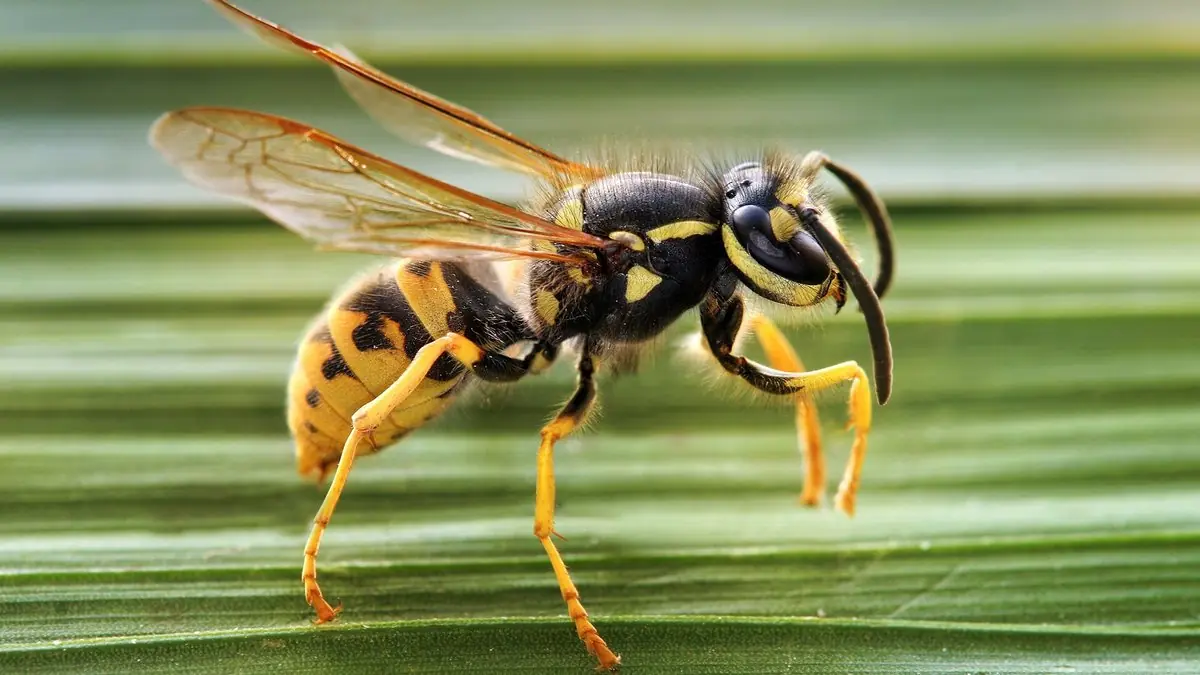
Workers are 12 to 16 mm long, bright yellow with black triangle-shaped markings, yellow legs and all-black antennae. They fly fast with legs tucked in and are drawn to meat, pet food and sweet drinks. The nest is hidden, usually in the ground. See the European wasp profile in our pest library.
Paper wasps
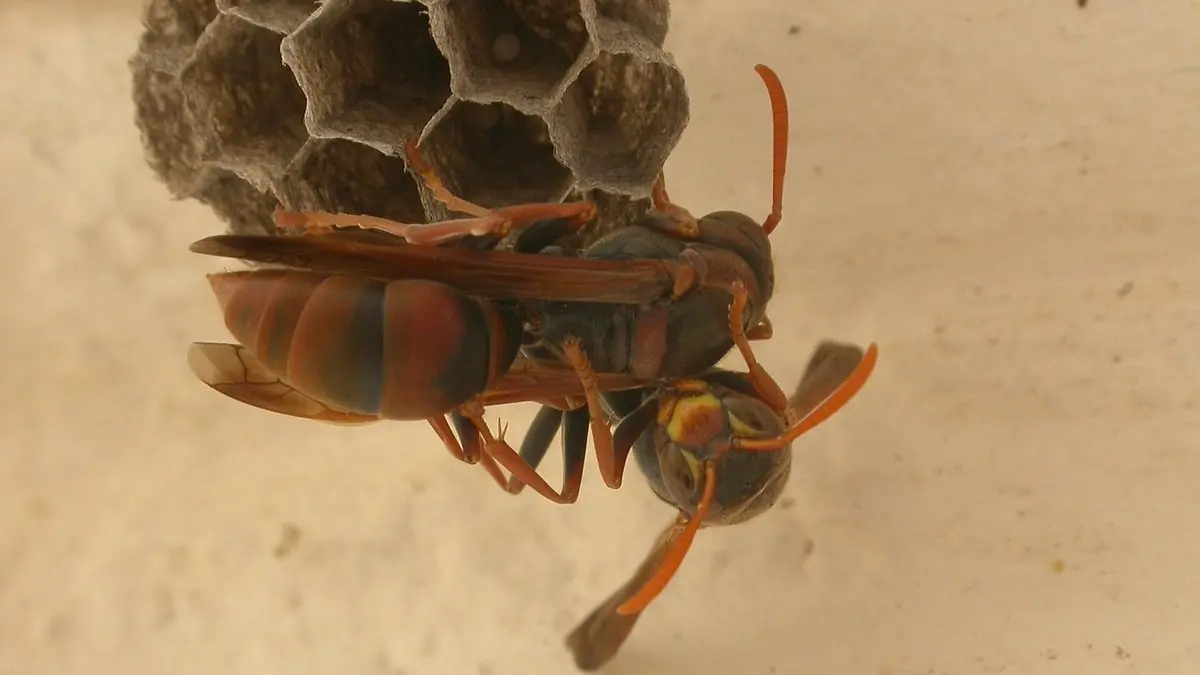
Three species are often mistaken for European wasps in Victoria: the introduced European paper wasp (yellow and black), the introduced Asian paper wasp (black with yellow stripes) and the native Australian paper wasp (orange-brown). They are slimmer, let their back legs dangle in flight and build open, umbrella-shaped nests under eaves, on fences and in shrubs.
Honey bee
Rounder and hairy where wasps are smooth, with black legs rather than yellow (a quick check Bayside council suggests). A bee stings once and leaves its sting behind. Swarms are collected by beekeepers, so read about honey bees and swarms before you book anyone.
Mud-daubers and solitary wasps
Most Australian wasps live alone, nest in the ground or in cracks and do not attack people. A nest made of mud is not a European wasp nest. Mud-daubers can sting painfully, but attacks are rare, so these nests can usually be left where they are.
European wasp, paper wasp or honey bee?
| Check | European wasp | Paper wasps | Honey bee |
|---|---|---|---|
| Body | Slender and smooth, bright yellow and black | Slender; yellow and black, black and yellow, or orange-brown, by species | Rounder and hairy, dark yellow-orange and black |
| Size | Workers 12 to 16 mm; queens 17 to 20 mm | 10 to 15 mm (Australian) or 13 to 25 mm (Asian) | About 12 to 15 mm |
| Legs and antennae | Yellow legs, all-black antennae | Antennae not black; back legs dangle in flight | Black legs |
| Nest | Enclosed, grey and papery, in the ground or a cavity; you see an entrance hole about 2 to 5 cm wide | Open umbrella of six-sided cells, from golf-ball to side-plate size | A swarm hanging in a cluster, or a colony inside a wall or roof |
| Sting | Can sting again and again | Australian paper wasps defend their nest | Stings once; the barbed sting stays in the skin |
| Who to call | A licensed pest controller | A licensed pest controller, if the nest is where people brush past it | A beekeeper first |
Signs of a European wasp nest on your property
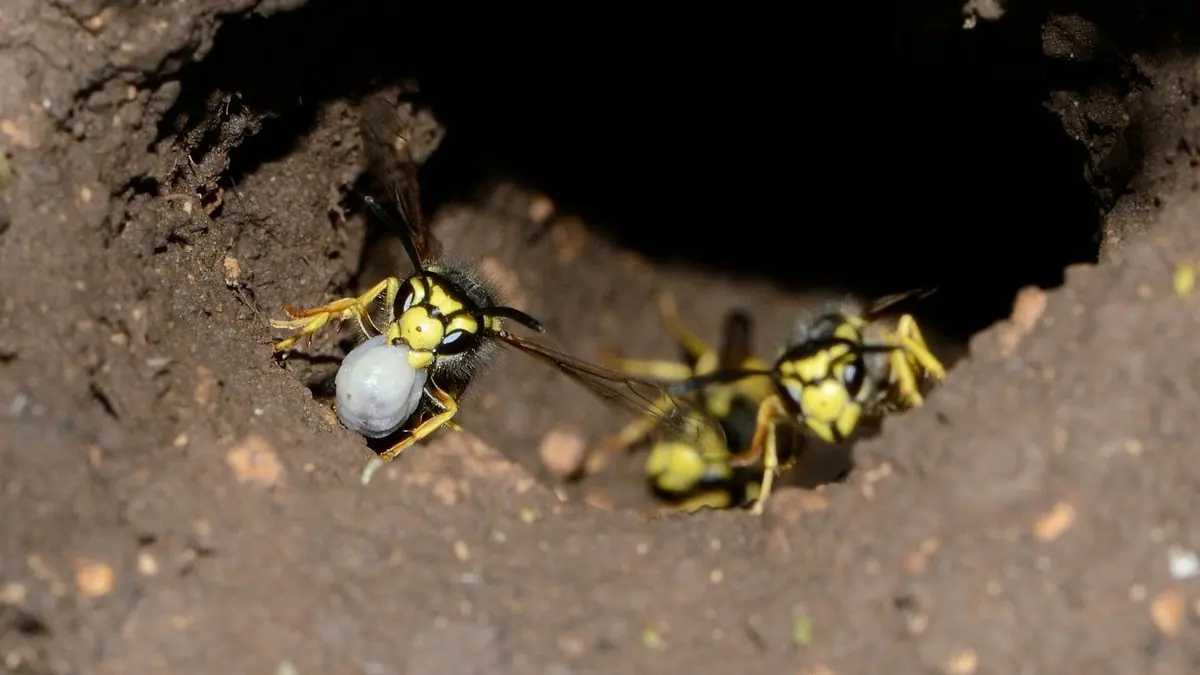
About 80 per cent of European wasp nests are in or close to the ground and most of the rest are in roof or wall cavities, according to Agriculture Victoria. You rarely see the nest itself; you see the traffic.
- Wasps flying in an almost straight line to and from the same spot, all day
- A busy hole in the lawn, a garden bed, a rockery or a retaining wall
- Wasps coming and going at the base of a tree, along a hedge or under the compost heap
- Wasps slipping into a gap in the eaves, the roof or a wall
- A neat entrance hole about 2 to 5 cm wide; where the nest is exposed, it looks light grey and cardboard-like
- Wasps going in and out of old hard rubbish or a sheltered spot beside the house or shed
- Several wasps at the pet bowl, the bins or the barbecue every day. This is a clue, not proof: they forage up to about 500 m from the nest
When European wasps are active in Melbourne
Nests follow the seasons. This is the Victorian cycle described by Agriculture Victoria and the Department of Health; our Melbourne pest calendar shows how it fits with other pests through the year.
| Months | What the nest is doing | What it means for you |
|---|---|---|
| September to November (spring) | A queen that spent winter in hibernation starts a new nest on her own | Nests are at their smallest, so spring is a good time to find one early |
| December to February (summer) | The nest grows in size and wasp numbers | More wasps at barbecues, pools and bins; nests get easier to spot and harder to approach |
| March (early autumn) | Numbers peak | The most wasps you will see all year, around gardens and outdoor eating |
| April and May (later autumn) | Males are produced, then new queens in late autumn; after mating, nests usually decline | Activity tapers off, but a nest that is still busy is still worth treating |
| June to August (winter) | Most nests die out, but in mild winters some survive | A surviving nest starts spring with a head start and many queens and can grow very large, so do not wait for winter to fix it |
Why DIY wasp nest removal often goes wrong
Nothing stops you trying, and one council, Monash, publishes steps for dusting a nest at night. The same page tells anyone who may be allergic not to attempt it, and Bayside council tells residents not to try at all. We side with the cautious advice, for three reasons.
- The nest defends itself. A disturbed European wasp stings repeatedly and releases a scent that calls other wasps from the colony to attack.
- You may not know your allergy status. Better Health Channel says about 1 in 10 people stung two or more times become allergic, and singles out people who have never been stung.
- The nest is usually out of reach. Ground nests sit below the surface and cavity nests sit behind a wall or roof, so you are working at the entrance, often on a ladder, with the colony coming out at you.
Hardware-store sprays and traps deal with the wasps you can see. A nest can hold thousands of wasps, and some hold more than 100,000, so knocking down foragers changes little while the colony keeps producing more. Never pour petrol or other fuel into a nest, never block the entrance, and do not try to dig a nest out.
What is worth trying first, and what to skip
Our guide to finding a European wasp nest explains the bait method in detail.
Skip these
- Spraying the entrance in daylight while wasps are flying
- Blocking the hole with soil, a rock or a bucket
- Pouring petrol or any other liquid into the nest
- Hosing, digging or hitting a nest
- Waiting for winter to kill it
Worth doing today
- Keep children and pets away from the area, and inside if the wasps are close to the house
- Find the nest from a distance: put out a little meat or pet food, watch which way wasps fly off, and move the food closer until you see the entrance
- Check over the fence, because the nest may be on a neighbour’s land
- Photograph the entrance from well back and text it to 0485 511 588
- Cover food and drinks outdoors, and drink from a clear cup or with a straw rather than from a can
Tell us where the wasps are
Give us your suburb and where you see them going in: ground, wall, roof or shed. We usually respond within the hour during business hours, and the phones are answered 24/7 for emergencies.
Thanks. Your request is in.
Your reference is . We usually respond within the hour during business hours. Need us sooner? Call 0485 511 588.
How our wasp nest treatment works, step by step
- 1
Tell us what you see
Call 03 9125 4034 or text a photo taken from well back to 0485 511 588. Tell us where the wasps go in, how high it is, whether anyone in the house is allergic, pregnant or has a baby, and which pets you have.
- 2
Confirm it is a European wasp nest
The technician checks the species first. Honey bees go to a beekeeper where possible, and a mud nest usually needs nothing, so you do not pay for a treatment you do not need.
- 3
Find every nest
Following the flight line, we locate the entrance and check for other nests nearby, as the Department of Health’s guidance asks. If the nest is over the fence, we need your neighbour’s permission to reach it.
- 4
Work when wasps are quiet
Where we can, we treat early in the morning or at night, when wasps are less active. The technician wears protective clothing and a bee veil and, after dark, uses a red-filtered torch, because white light can draw wasps.
- 5
Treat the nest at its entrance
We apply an APVMA-registered insecticide at the nest, chosen to suit where it sits (soil, wall or roof void) and used strictly according to the label. The nest does not have to be dug out or opened up.
- 6
Leave you with clear instructions
Before leaving, we tell you how long to keep people and pets away from the entrance, what activity to expect, and what to do if wasps are still busy there after that time.
Where the treatment reaches, and where it has limits
Most nests sit in lawns, garden beds, rockeries, retaining walls, hedges, tree bases, compost heaps and sheds, or in gaps around eaves that can be reached from the ground or a ladder. Those are the accessible nests the starting price is for.
Some jobs need more: a nest high on a two-storey roofline, inside a wall cavity with no reachable entrance, or under a deck. We tell you the price for those before we start. A nest on a neighbour’s property can only be treated with their permission.
Treatment deals with that colony; it does not keep every wasp away. European wasps forage up to about half a kilometre from their nest, so you may still see a few at the barbecue from a nest down the street. Each spring new queens start new nests, so a nest in the same garden next year is most likely a new one.
Honey bee swarms we refer to a beekeeper wherever possible, as councils do; treating an established hive is a last resort. Our guide on bee swarms and bees in walls explains who to call.
Before we arrive
- Keep children and pets inside, away from where the wasps are flying
- Tell us about allergies, asthma, pregnancy, babies and every pet in the house
- Leave the side gate or shed open so the technician can reach the nest without coming through the house
- Bring in pet bowls and cover any fish pond near the nest
- Close nearby doors and windows, and let your neighbours know if the nest is near the fence
- Leave the nest alone: no spraying, blocking or poking it beforehand
After the treatment
- Keep people and pets away from the entrance for as long as the technician advises
- Leave the entrance and any dust undisturbed: do not hose, block, dig or mow over it
- Expect some wasps around the entrance at first, and do not swat at them near the hole
- If wasps are still busy at the same entrance after the time you were given, call us on 03 9125 4034
What wasp nest removal costs
One accessible European wasp nest has a fixed starting price, and every price below includes GST.
- European wasp nest removalOne accessible nest: identification, treatment and after-care advicefrom $189 inc. GST
- Wasp nest on the same visit as a home treatmentAdded to an Essential, Complete or Total Protection packagefrom $129 inc. GST
- Complete home package, house up to 3 bedroomsInside, perimeter, roof void and sub-floor, with the wasp nest add-on availablefrom $279 inc. GST
Prices are from, including GST. A nest high on a two-storey roofline, inside a wall cavity or more than one nest may cost more, and we confirm that price before we start. See every price on our pricing page.
What the treatment covers, and your rights
The treatment is aimed at the nest we found and treated. It cannot cover a new nest that a new queen starts somewhere else next spring, or wasps flying in from a nest on another property. If wasps are still busy at the treated entrance after the time we gave you, call us so we can check it. Ask about warranty terms for your job when you book; warranty conditions apply.
Any warranty sits on top of your rights under the Australian Consumer Law, which require any service to be provided with due care and skill.
Who is responsible for a wasp nest? What your council says
On private land the nest is the owner’s or occupier’s responsibility in all five council areas below. Councils deal with nests on their own land, such as parks, reserves and nature strips.
| Council | Suburb | Nest on private property | Nest on council land |
|---|---|---|---|
| Bayside | Brighton | No pest control on private property; the council says not to try it yourself and to use a licensed pest controller | Report it to the council |
| Port Phillip | St Kilda | Contact a licensed pest control operator | Report nests on public land to the council |
| Stonnington | Toorak | A local law requires the owner and occupier to have the nest removed by an appropriate contractor | Report bee and wasp issues through the council’s online form |
| Glen Eira | Caulfield | The council does not remove bees or wasps from private property | Phone the council about nests on council property |
| Monash | Oakleigh | Destroying the nest is the property owner’s responsibility; the council recommends a licensed pest controller | Report nests in parks, reserves and nature strips to the council |
Wasp myths, and what is actually true
“Wasps die after one sting.”
That is honey bees. A European wasp can sting again and again.
“Winter will kill the nest.”
Most nests die out, but in southern Australia’s mild winters some survive and grow much bigger the next season.
“They are in my yard, so the nest is too.”
Wasps forage up to about half a kilometre from the nest. Follow them before you assume.
“The council will remove it.”
Not on private property, in any of the five council areas listed above.
“A beekeeper can take the nest.”
Beekeepers are not licensed to use pesticides. Wasp nests go to a licensed pest control operator.
“Every yellow-and-black wasp is a European wasp.”
Three paper wasp species in Victoria are commonly mistaken for it. Check the legs, antennae and nest.
How to make your yard less attractive to European wasps
- Pick up fallen fruit and food scraps, especially under fruit trees in summer
- Do not leave pet food or dog bones outside
- Keep tight lids on bins and keep compost covered
- Cover the pool when it is not in use
- Cover food at barbecues and picnics
- Clear out old hard rubbish and fill in disused holes in the ground
- Walk the garden in spring and early summer, watching for steady wasp traffic at tree bases, hedges, retaining walls and rockeries while nests are small
- Booking a home pest treatment? Mention any wasp activity so a nest can be treated on the same visit
Wasp and bee guides
Wasp nest removal in our main service areas
Sources for this page
The wasp facts, seasons and first aid on this page come from Victorian government and council sources, checked in November 2026.
Wasp Nest Removal: common questions
How much does it cost to remove a wasp nest in Melbourne?
Our European wasp nest removal starts from $189 including GST for one accessible nest. If we are already treating your home, a nest on the same visit is $129 including GST. Nests high in a roof, inside a wall cavity or under a deck can take more work, and we confirm that price before we start. Every price is on our pricing page.
Can I remove a wasp nest myself?
Some people do, but it is the riskiest way to deal with one. A disturbed nest sends out wasps that sting repeatedly, and you may not know whether you are allergic. Better Health Channel recommends a licensed pest control operator, and Bayside council tells residents not to try. If you are allergic, or have never been stung, do not attempt it.
Will wasps come back if you destroy their nest?
A treated colony dies out, but wasps can still turn up. Foragers from other nests travel up to about half a kilometre, and each spring new queens start new nests. A nest in the same spot next year is most likely a new one. Keeping food, bins and fallen fruit tidy makes your yard less attractive to them.
Will the council remove a wasp nest for free?
Not from private property. Bayside, Port Phillip, Stonnington, Glen Eira and Monash councils all leave nests on private land to the owner or occupier. Councils do deal with nests on their own land, such as parks, reserves and nature strips, so report those to the council rather than treating them yourself.
Who pays for wasp nest removal in a rental property?
Tell your rental provider or agent as soon as you notice the nest. Consumer Affairs Victoria says the law does not always say who must fix or pay for a pest problem; check your rental agreement first, and where it is silent, it can depend on who caused or contributed to the problem. If you cannot agree, either side can apply to VCAT.
Does wasp nest spray from the hardware store work?
It kills the wasps it hits, but a nest can hold thousands of workers, and spray at the entrance may not reach the colony deep inside the ground or a wall. Spraying also provokes the wasps. If you use any product, read and follow its label, and never pour fuel into a nest or block the entrance.
Do you remove bee swarms?
We refer honey bee swarms to a beekeeper wherever possible, because beekeepers collect swarms rather than destroy them, and Bayside council notes swarms often move on within two to three days. Treating an established hive is a last resort when it cannot be removed and is a risk to people. Read our guide to bee swarms and bees in walls.